Decision-Centred Modelling (DCM)
Foundations, Architecture, and Application to Industrial Process Heat Decarbonisation
2026
Foundations, Architecture, and Application to Industrial Process Heat Decarbonisation
"The decision makes the boundary; the artefact makes the connection."
Read the Framework → GitHub DiscussThe Central Problem
Most planning problems look tractable until you realise that the consequences which will determine whether your decision was right lie outside the model you used to make it. Outside the physical boundary. Outside the time horizon. Outside the organisational perimeter. Outside the domain any single expert was trained to see.
This framework is a response to that structural problem. It applies to infrastructure planning, corporate strategy, policy design, financial decisions, and anywhere that long-horizon commitments interact with genuine uncertainty and multiple stakeholders who see the same situation differently.
This Framework Is For
Researchers
Working on DMDU, integrated assessment, and complex systems. The architecture provides a modular, governed basis for multi-scale exploration.
Practitioners
Infrastructure planners, energy analysts, and strategists navigating long-horizon commitments under genuine uncertainty.
Policymakers
Seeking analyses that reveal system-level incentive misalignments invisible to single-perspective assessments.
Anyone
Facing decisions where the most consequential outcomes lie outside the frame you started with. The thinking applies far beyond engineering.
Four Principles
Decision First
Boundaries are drawn by the decision context, not by physical system extent. The model develops toward what influences the decision, not toward completeness of the system description.
Governed Artefacts
Every output that enters the comparison chain is schema-conforming, provenance-carrying, and validation-gated. Without governance, results cannot be trusted across versions or questioned after the fact.
Deep Uncertainty
When probabilities over futures are contested, the right standard is robustness: how does this choice perform across the range of conditions that cannot be agreed upon?
Progressive Refinement
A bounded, honest starting point that reveals its own next steps is more valuable than a comprehensive but opaque system. The architecture is designed to grow toward what matters.
The Framework at a Glance
Diagram 1: Seven analytical layers — from facility demand construction through the governed backbone to the decision layer.
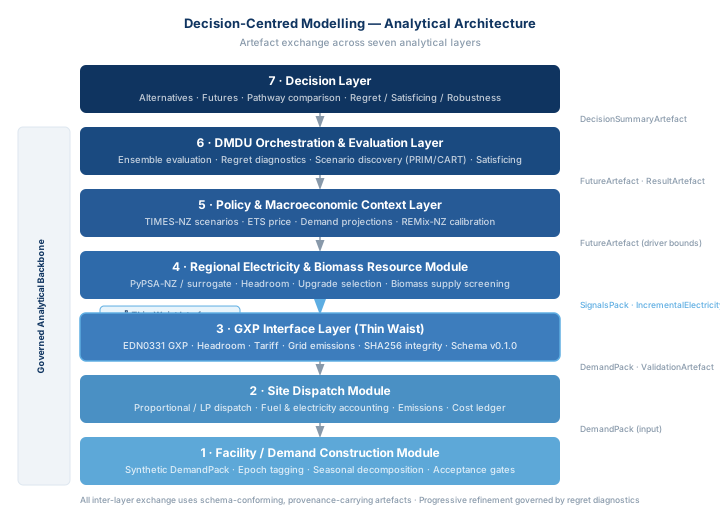
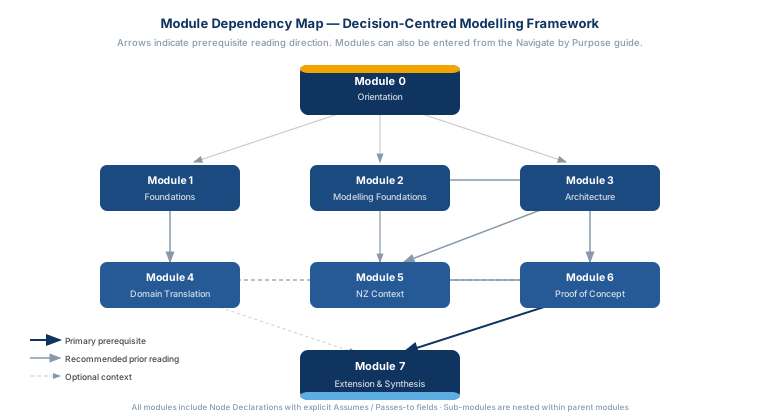
Diagram 2: Module dependency map — prerequisite reading paths across Modules 0 through 7.
Navigate by Purpose
| If you are... | Start here |
|---|---|
| New to this framework — start here | Module 0: Orientation (15 min) |
| A researcher in DMDU, integrated assessment, or systems modelling | Part I: The Decision Problem |
| An energy system modeller or tool developer | Part II: The Framework Design |
| A practitioner or corporate strategist | Module 4: Domain Translation |
| Working in NZ energy policy or infrastructure | Module 5: NZ Context |
| Interested in the full proof of concept and results | Part IV: The Proof of Concept |
| Evaluating the intellectual contribution | Module 7 §7.6: Eleven Propositions |
| Thinking about applying this outside energy systems | Module 7 §7.9: Beyond Infrastructure |
| Wanting to contribute a domain extension | GitHub Discussions |
How to cite this work
Mahmoudi Lahijani, S.A. (2026). Decision-Centred Modelling (DCM): Foundations, Architecture, and Application to Industrial Process Heat Decarbonisation. Open framework platform. Auckland University of Technology. https://ahmad-mahmoudi-coder.github.io/DCM/
Related publications
Lahijani, A.M., Protheroe, M.D. &
Gschwendtner, M. (2025). A modelling tool
selection for decarbonising industrial process
heat systems. Renewable & Sustainable
Energy Reviews, 210, 115149.
doi:10.1016/j.rser.2024.115149
PhD thesis and preprint: available after
examination and submission (2026).
Seyed Ahmad Mahmoudi Lahijani — 2026 · Auckland University of Technology · Repository · Glossary · Contribute
Licensed under CC BY 4.0 — content may be reused with attribution.